JC Penny had an aggressive Search Engine Optimization campaign using SearchDex. When the NY Times discovered the blatant search engine manipulation , Google finally stepped in, and manually (over)compensated for the “grey-hat” SEO tactics.
Up until that point, however, I would suggest that JC Penny received millions of dollars in extra revenue from the traffic that was generated by these tactics, the most problematic of which include paid (or unnatural) links from unrelated websites and pages. Websites such as www.piano-player-for-hire.com have no business linking to that type of retailer. Sure – once, twice, even 100 times could potentially consist of happy consumers. But 700+ links from unrelated websites, with perfect descriptive anchor texts? There’s no way that it’s natural.
Still, Google had to manually take corrective action, after the NY Times wrote its article. That tells me two things:
1. The tactic still works – it wasn’t the algorithm that detected all of these unnatural links; Google manually brought their rankings down.
2. The claim that “Any press is good press” is decidedly incorrect, especially if you’re using black- or grey-hat SEO . If the NY Times had never published the article, it’s unlikely that Google would have manually penalized them.
The fact that link-building and link-spamming still work should indicate the prominent nature of links in Google’s algorithm. If links were a minor deal – say links were given 25% of the total algorithm’s weight – then we wouldn’t still have this problem, since Google would simply remove it altogether. Links are central to Google’s concept of domain authority and page relevance. This is nothing new; we’ve known this for a long time. This should, however, be a reminder to create quality content on your site and participate in other link-baiting activities. Especially in low- and medium-competition SERPs (Search Engine Results Pages), one or two high-quality, relevant links could mean the difference of ranking at the bottom of page two or the top of page one. In high-competition SERPs, links are all the more vital.
Still, I have to wonder if even after Google’s manual penalty JCPenny came out ahead. Ignoring their profits prior to the manual penalization, take a look at their current SERP rankings. Although Google penalized them, Bing/Yahoo and Ask still rank them much higher than natural – often in the first or second place for some highly competitive keywords – try “reversible comforters” in Bing.
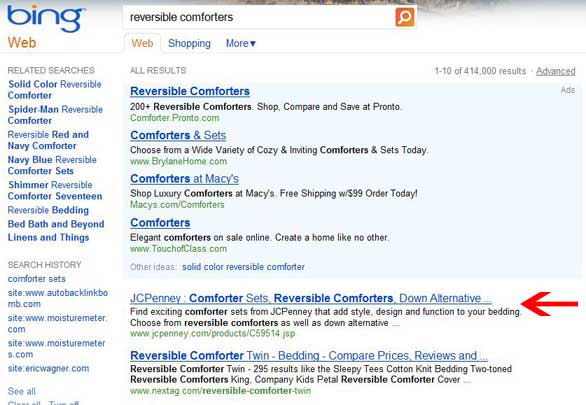
If, for simplicity’s sake, we assume that the Bing/Yahoo partnership has about 20% of the total searches for “reversible comforters”, and Google has the other 80% , and assume because of these statistics that first position gets about 40% of the search traffic, we can deduce the following:
- Position 1 in the Bing SERPs is about 8% of the overall search traffic
Before JCPenny began using their link-building strategy, it is unlikely that they ranked anywhere on the first page of any Search Engines’ SERPs (all the competing pages have more legitimate links and relevant content), and probably didn’t get more than 1% of the overall traffic from this search.
If these numbers are accurate, then JCPenny is still benefiting from 8 times as many visitors as they would be without their unnatural link-building methods.
Is black-hat SEO better than white-hat SEO? I still say no. But it is important to realize that cheaters do prosper. At least in the short term, while search engines are still using outdated link-valuing algorithms while frantically attempting to come up with countermeasures. But its not necessary for white-hat SEO experts to sit by idly while their black-hat competitors rank the competition – awesome content creation will always draw in users like a magnet, and people will naturally want to link to it. Promoting that content on your facebook and twitter will get the word out to potential linkers, and even asking industry professionals to review your product and link to its page is a legitimate way to get quality links on relevant pages and websites.
The risks involved in black-hat SEO go beyond Google’s penalizations – your brand’s reputation is also on the line. After you bring the visitor to your site, you still need their respect to get the sale. Never trade away customers for visitors.

